2026-02-18
Graph Paper vs. Dot Grid: Which One Should You Use?
Both sheets give you a repeating unit. They just get in your way differently.
Graph paper is a full grid. Great when the square is the point: coordinate sketches, pixel art, knitting charts, “this box is 5 mm.” Heavy every fifth line and it starts to feel like engineering paper. For US Letter homework that expects quarter-inch squares, open 1/4 inch graph paper.
Dot grid keeps the same spacing but drops the lines. That’s why bullet journals and weekly logs like it — the page still lines up, but it doesn’t look like homework. 5 mm is the usual planner spacing; 7.5–10 mm if you’re writing large or mapping a week.
Two tasks with the same 5 mm spacing
These are detail diagrams drawn in millimeter coordinates, not photographs of printed output. Gray guides represent the paper; green outlines and text represent marks added by hand after printing. The tools do not draw rooms or fill in plans automatically. Images resize with your screen and are not on-screen rulers.
Graph example: sketch a 4 m × 3 m room
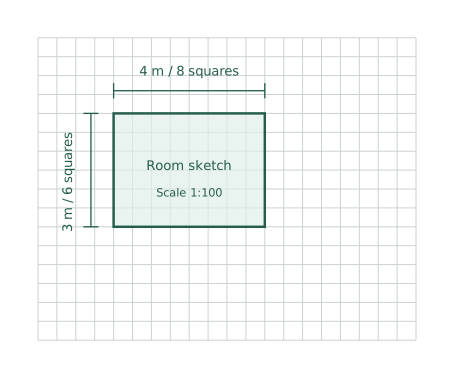
- Open the graph paper tool. Choose portrait A4, 10 mm margins on all sides, a 5 mm grid, and no emphasized major lines.
- Download the PDF and print at Actual size. Check that 10 intervals span about 50 mm; use the print-scale checklist if they do not.
- At 1:100, 1 meter becomes 10 mm on paper, so each square represents 0.5 meters. Count 8 squares across and 6 down for the outline.
- Convert furniture dimensions using the same scale. A full grid helps when repeatedly counting and aligning lengths.
This is a layout sketch, not a substitute for site measurements or construction drawings. Use coordinate paper for numbered axes and isometric paper for a three-dimensional sketch.
Dot-grid example: lay out a five-day plan
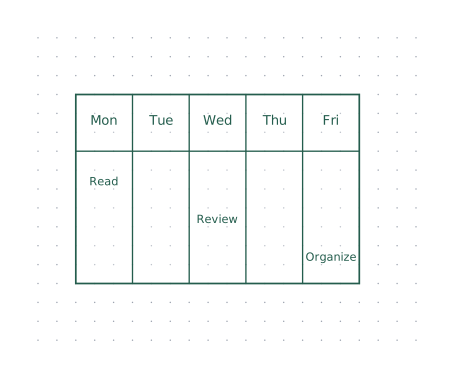
- Open the dot grid tool. Choose portrait A4, 10 mm margins, 5 mm spacing, and a 1.5 px dot size.
- Download and print the PDF at Actual size. Draw a divider every 3 dot intervals: each column is 15 mm wide, and five total 75 mm. Count gaps rather than dots.
- For larger writing, use 4 intervals per column: 20 mm each, or 100 mm total. Decide the width before adding headings.
- Draw only the heading rules you need, then align text to the dots. Add small tracking boxes separately if useful.
Graph paper can hold the same plan; dot grid simply supplies fewer fixed lines. For ready-made period rows and weekday headings, use the timetable tool instead.
A quick pick
- Math homework, scale drawings, tables → graph paper
- Planners, mixed writing and boxes, light sketching → dot grid
- Function graphs with axes → coordinate paper
- Cubes, rooms, isometric game maps → isometric grid
You can print either as PDF from the generators. Use Actual size so a 5 mm grid stays 5 mm on the page, not “whatever Fit to page decided.” Step-by-step print settings: print templates at the correct size.
Related tool:Open the graph paper generator →